05Our Publications
Research outputs on digital literacy
Publications by the Hub
Reports from the Hub's own research, with the data behind them.
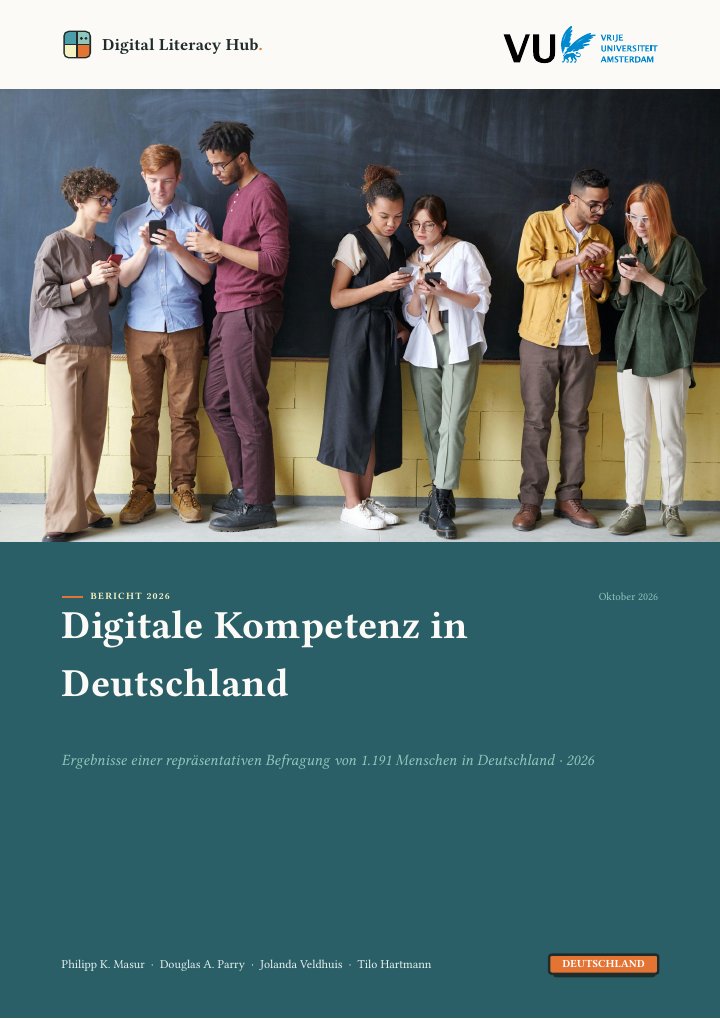
Digitale Kompetenz in Deutschland
Ergebnisse einer repräsentativen Befragung von 1.191 Menschen in Deutschland
Digital literacy in Germany: Results of a representative survey of 1,191 people in Germany
Masur, P. K., Parry, D. A., Veldhuis, J. & Hartmann, T.
How digitally literate are people in Germany? This report presents a 2026 survey of 1,191 adults, representative of the population by age, gender, education and region. We measure four competencies (operating devices and settings, evaluating information, dealing with others, creating content) across seven digital domains, from privacy to generative AI. Most people get by, but about one in seven feel unsure in almost every situation we asked about. People are weakest with algorithms and generative AI, younger people are clearly more competent than older people, and more competent people feel more equal to the digital world but hardly less burdened.
Permanent link: hdl.handle.net/1871.1/b700a1ee-6b44-418b-b94d-4049fa42d14c
Tools built on this survey: Test your digital literacy · Explore our research data

Digitale geletterdheid in Nederland
Resultaten van een representatief onderzoek onder 1181 mensen in Nederland
Digital literacy in the Netherlands: Results of a representative survey of 1,181 people in the Netherlands
Masur, P. K., Parry, D. A., Veldhuis, J. & Hartmann, T.
How digitally literate are people in the Netherlands? This report presents a 2026 survey of 1,181 adults, representative of the population by age, gender, education and region. We measure four competencies (operating devices and settings, evaluating information, dealing with others, creating content) across seven digital domains, from privacy to generative AI. Most Dutch people get by well, but about one in ten feel unsure in almost every situation we asked about. Respondents are least skilled with algorithms and generative AI, younger people are clearly more skilled than older people, and teaching oneself is the most common way people learn.
Permanent link: hdl.handle.net/1871.1/c4200b8e-0e41-49ae-8bc2-aeeb6e363a09
Tools built on this survey: Test your digital literacy · Explore our research data
Publications by Hub members
Research by our members on digital literacy and related topics.
The promise and peril of social media: How context shapes online risks and digital literacy among adolescents in a semi-rural South African community
Steytler, M. M., Parry, D. A.
When Sharing Becomes the Norm: How Disclosure Prevalence and Relational Similarity Shape Social Norms on Social Media
Masur, P. K., Parry, D. A.
Does the mere presence of smartphones impact cognition in the high school classroom?
le Roux, D. B., Parry, D. A., Feldman, J.
Escaping the Digital Panopticon? Longitudinal Effects of Dataveillance Salience Shocks on Privacy Attitudes and Inhibited Behaviors
Meier, Y., Masur, P. K.
Examining learners' engagement patterns and knowledge outcome in an experiential learning intervention for youth's social media literacy
Zou, W., Purington Drake, A., Masur, P. K., Whitlock, J., Bazarova, N. N.
Social Media and Youth Mental Health: Simple Narratives Produce Biased Interpretations
Sewall, C., Parry, D. A.